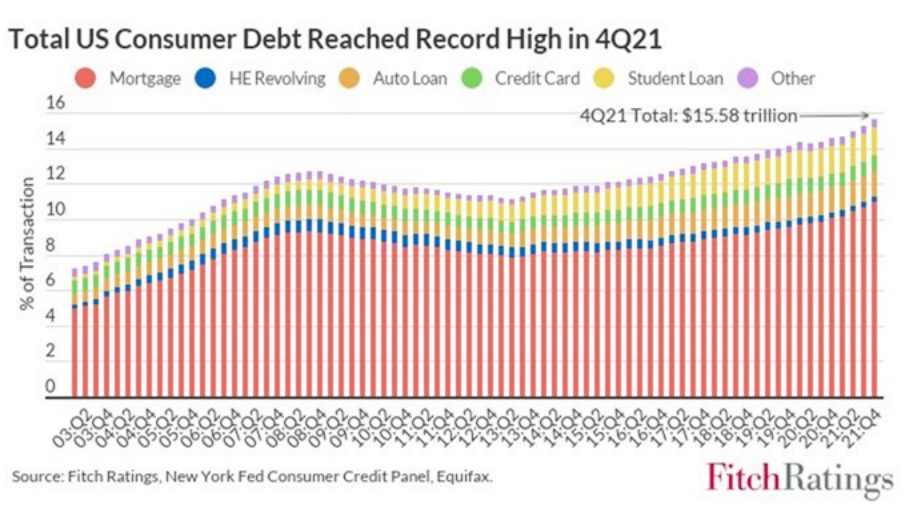
A graph showing total U.S. consumer debt of various types from 2003 to 2021, showing that mortgage debt made up the vast majority of U.S. consumer debt in all years measured, around \(70\%\) in 2022, while student loan debt had increased over time to become the second-largest source of U.S. consumer debt, making up around \(35\%\) of non-mortgage debt in 2022. Source: Fitch Ratings, New York Fed Consumer Credit Panel, Equifax.
Figure2.5.1.A graph showing total U.S. consumer debt of various types from 2003 to 2021.
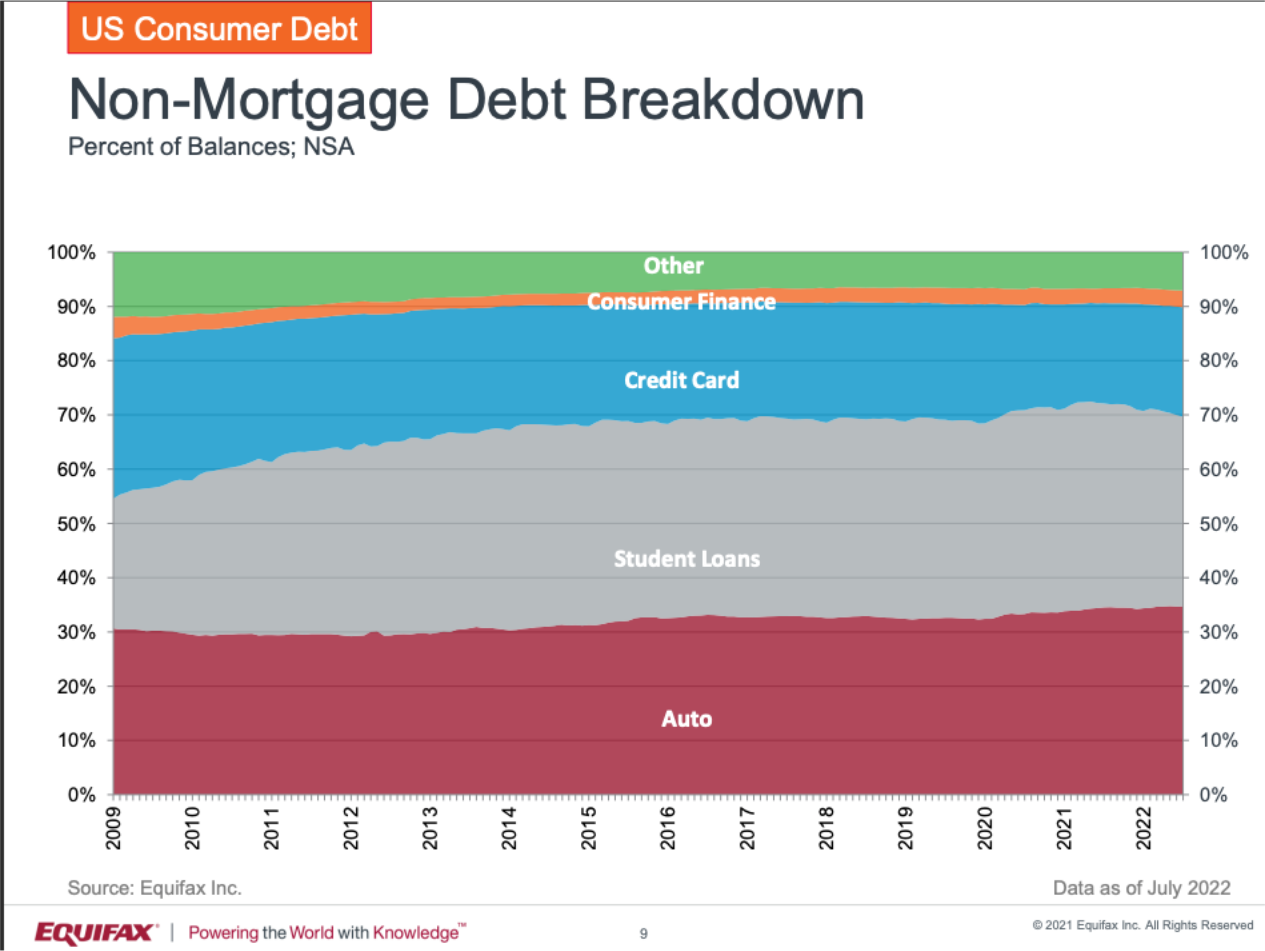
Breakdown of the percentage of U.S. non-mortgage consumer debt from 2009 to 2022 showing the following approximate 2022 distribution: \(35\%\) auto debt, \(35\%\) student loan debt, \(20\%\) credit card debt, \(3\%\) consumer finance, \(7\%\) "other". Source: Equifax Inc., 2022.
Figure2.5.2.Breakdown of the percentage of U.S. non-mortgage consumer debt from 2009 to 2022.
Create a graph, trendline, and interpret the \(R^{2}\) value for each type of institution: public nonprofit, private nonprofit, private for-profit. What does it mean? Use it to predict average tuition and fees across the country in the current year. How accurate is your prediction?
Fit the data to a polynomial function (of least degree). We’ll talk about how to do this in class, so let your instructor know when you reach this step. For your reference, the steps in Excel are:
Left-click on your graph. In the top menu under "Chart Tools", click Design. Click Add Chart Element -> Trendline -> More trendline options. Click on the data you want to make a trendline for. In the right sidebar, select Polynomial and play around with the "Order" until you get a good fit for your data. Check "Display Equation on chart" and "Display R-squared value on chart". Now, our goal is to get all our \(R^{2}\) values larger than roughly 0.96, which is a very large degree of accuracy. If some of your trendlines have \(R^{2}\leq0.96\text{,}\) double-click on the offending trendline(s) until the sidebar comes up and increase the "Order" of your polynomial until \(R^{2}\gt 0.96\text{.}\)
What trends over time do you notice in each the three graphs? Describe trends in words, using phrases like "increasing", "decreasing", "increasing slope", "decreasing slope". What overall trend do we notice that’s common to all three graphs over time?
The \(R\)-squared value that you were asked to show in Exercise 2.5.3 above measures what proportion of the variation in the \(y\)-variable is explained by the trendline. For instance, \(R^{2}=1\) means that \(100\%\) of the variation in y is explained by the trendline, so the trendline is a perfect fit. Conversely, \(R^{2}=0\) means that the trendline explains \(0\%\) of the variation in the \(y\) variable, so this trendline doesn’t fit the data at all.What percentage of the variation in two-year public college tuition (\(y\)) is explained by the variation in year (\(x\))? What about when \(y=\) four-year private college tuition? Four-year public college tuition?
Outliers are data that fall far away from the trendline. What outliers do you notice, if any? Interpret these outliers in context: what do they mean for tuition and fees over time, and what possible historical explanations could there be for these outliers?
Polynomials are a special type of mathematical function, or process for turning one number into another. Polynomials are functions of the form \(f(x)=a_{n}x^{n}+a_{n-1}x^{n-1}+\dots+a_{1}x^{1}+a_{0}\text{:}\) sums of powers of \(x\text{,}\) maybe with constant terms in front. For example, \(f(x)=x+1\text{,}\)\(g(x)=17x^{3}-234x+7\text{,}\) and \(h(x)=-x^{1}42+1\) are all polynomials. The polynomial \(a(x)=x^{2}+2x+3\) takes the input 1 and turns it into the output \(1^{2}+2(1)+3=6\text{.}\) All numbers which make sense to input are called the domain of the function, and the possible sensical outputs you could get are called the range.What is the domain and range of each of the polynomial trendlines?
Use this model to predict the tuition cost for a student entering each type of institution in the academic year current academic year. How accurate do you think your prediction is?
Use the model to predict the tuition cost for a student entering a public two-year college in the academic years \(2050\)-\(2051\text{,}\)\(2100\)-\(2101\text{,}\) and \(1900\)-\(1901\text{.}\) How accurate do you think your predictions are?
to describe recent trends at your own institution in the same way. Is your college or university better or worse in amount of student debt than the average in the US? The average for institutions of the same type?