. Additionally, the amount of funding for higher education provided by state governments has declined from around \(70\%\) in the \(1970\)s to slightly under \(60\%\) in \(2019\text{.}\)
The Wharton School also released the data in Table 2.7.1 on the distribution of student loan forgiveness benefits by income under the \(2022\) Biden student loan forgiveness plan. Most of the debt forgiven would have accumulated for those in the \(25\)-\(35\) age group; hence, this column may be more representative of the plan’s effects. No benefit is expected to go to the top \(5\%\) of earners in either age group. Data from Wharton School of Business.
For each of the following questions, read the cited article, considering the listed questions. Then use what you’ve read, as well as your own thoughts, to make your best attempt at answering these questions. Finally, bring these attempts to class and discuss them with your group. Choose someone in your group to report your group’s conclusions during full-class discussion.
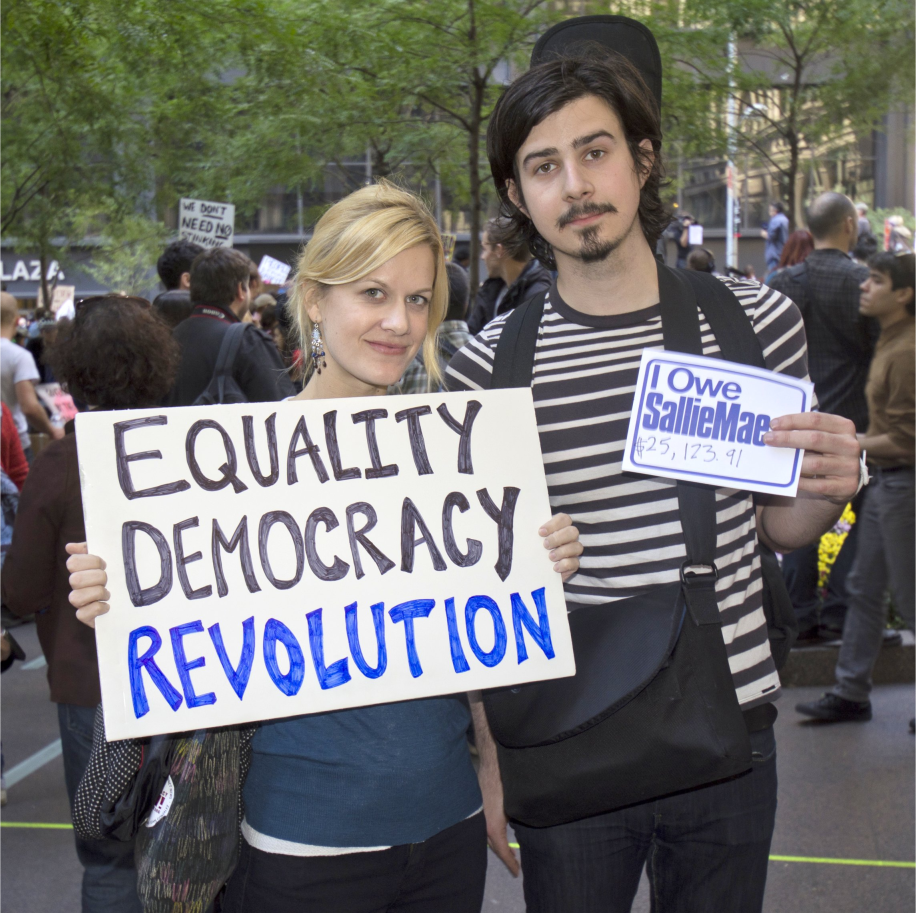
A photo of two Occupy Wall Street protesters, one of whom carries a sign saying "I Owe SallieMae \(\$25,123.91\text{.}\)" Photo by Bob Jagendorf entitled ``Occupy Wall Street - Student Loans’’ under a CC BY-NC 2.0 license.
Figure2.7.2.A photo of two Occupy Wall Street protesters, one of whom carries a sign saying "I Owe SallieMae \(\$25,123.91\text{.}\)" Photo by Bob Jagendorf entitled "Occupy Wall Street - Student Loans" under a CC BY-NC 2.0 license.
What should the Department of Education do with student loans held by other for-profit colleges, including those who were not as openly fraudulent as Corinthian (who paid companies to hire their students for two days in order to inflate their job placement numbers)?
If you are in one of the groups (single adults earning under \(\$125,000\) a year and married couples earning under \(\$250,000\) a year, plus an additional \(\$10,000\) for Pell Grant recipients) that President Biden targeted for debt forgiveness in \(2022\text{,}\) what amount of debt will you have forgiven?
Do you believe that President Biden’s student loan debt forgiveness policy is a good idea? Why or why not? Do its benefits for lower-income debtors outweigh its impats on the U.S. budget? Estimate whether your taxes will rise as a result and, if so, by how much, using a well-explained dimensional analysis.
The following note from the Wharton Budget Model describes the income groups listed in Table 2.7.1: “Estimate household income percentile thresholds for 2022 all age: 20%: $28,784; 40%: $50,795; 60%: $82,400; 80%: $141,096; 90% $212,209; 95%: $321,699; 99%: $961,711; 99.9%: $3,668,499.”
, a nonpartisan organization within the legislative branch of the United States government, estimated the total cost of Biden’s student loan forgiveness program at \(\$400\) billion. Use this estimate, together with the information above, to estimate how much total debt relief (in U.S. dollars) your income and age group wlil receive \(10\) years from now.
President Biden’s loan forgiveness program involves an “income cap”, which means that the program only applies to individuals who earn below \(\$125,000\) or households who earn below \(\$250,000\) each year. According to the Wharton analysis shown in Table 2.7.1, whether or not an income cap is applied, the most loan forgiveness would go to households earning between \(\$51,000\) and \(\$82,000\) a year.
Assuming that the loan forgiveness policy stays constant for the next \(10\) years, estimate the percentage of loan forgiveness that will apply to these income percentile(s). Make the simplifying assumption that all student loan borrowers are individuals and not households.